
The Lincoln-Douglas Seminar
With Mike Bietz
Full support for the 26/27 Season | 56 Lincoln-Douglas lectures this season, taught by a Tournament of Champions Hall of Fame coach and access to on-demand instruction.
WHO TEACHES IT

TOC Hall of Fame, 2024. First coach from Southern California and first Asian American inducted
President, National Debate Coaches Association, 2009 to 2011
Gold Key Society inductee, Emory University, 2022
TOC Advisory Committee, since 1996
Chuck Ballingal Community Service Award, University of Southern California, 2018
Minnesota Debate Coaches Association Coach of the Year, 2004
Assistant Coach of the Year, Minneapple, 1996
I have spent thirty years building high school debate programs. I started the Lincoln-Douglas program at Edina in Minnesota from nothing and took it to back-to-back state championships. I then spent seventeen years at Harvard-Westlake in Los Angeles, where the program had one debater when I arrived.
My programs qualified more Lincoln-Douglas entries to the Tournament of Champions than any other during the same period, 98 of them, and more than 100 counting every debate event the TOC holds. My students have won national championships at the TOC, NSDA Nationals, NDCA, and Novice Nationals, including two TOC champions and two NSDA champions. In 2004 two of my debaters won the TOC and the NSDA national championship in the same season, which no other coach has done. I am a past president of the National Debate Coaches Association, have served on the TOC Advisory Committee since 1996, and was inducted into the Tournament of Champions Hall of Fame in 2024.
I include that record for one reason. Ask any of those students what I talked to them about, and it was not winning. Whether a judge votes for you is not in your control. What is in your control is whether you understand an argument better this week than you did last week, whether you saw a response coming, and whether your rebuttal did what you meant it to do. That is what we worked on, and the results came out of it.
FROM A FORMER STUDENT
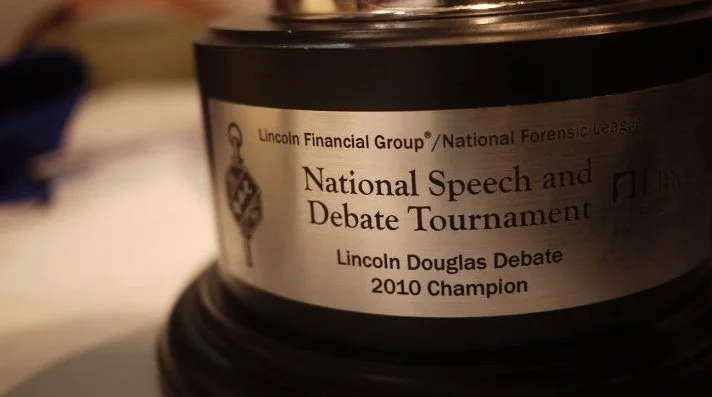
“Mike Bietz was one of the truly exceptional teachers I've had in my life. As coach, he cultivated a team environment that was both encouraging and supportive. He fostered our curiosity and motivated us into hard work. He taught us to navigate the emotions of competition, to ride the highs and lows. Learning to debate was a transformative experience for me. I am forever grateful that Mike Bietz was my coach.”
Ben Sprung-Keyser
Harvard-Westlake '11. Harvard College '15. Rhodes Scholar
Associate Professor, The Wharton School, University of Pennsylvania NSDA Lincoln-Douglas National Champion, 2010, as a junior. World Universities Debating Champion.
CREATING THE PLACE I WANTED TO SEND MY OWN DEBATERS
I know what practice looks like once the season is going: a tournament that weekend, a new topic in two weeks, twelve kids who each need something different, and maybe ninety minutes a week to do all of it on top of running the program. You triage. You work on the cases that are going to be read on Saturday.
I heard about this from parents constantly, even at a program that had everything. They could see their kid wanted more than any one coach can give twelve of them at once, and they were right. The student wanted to go deeper on something, or did not quite understand an argument and needed someone to sit down with them.
So they filled the gap wherever they could find it. A YouTube video from someone who debated for one season. Advice from an older teammate who half-remembered it. A camp lecture from two summers ago.
The students who got the most out of debate were the ones who ran into an idea partway through a season and could not let it go. A theory of justice, a school of criticism, a question they had never thought to ask. Ten years later that is what they are still doing something with. Living tournament to tournament does not leave room for that. Going deep does.
I always wanted a place I could send those students. Somewhere that would teach them, not just hand them arguments to read. There was never one.
This is that place.
When Your Season is Over
The question I heard most often from parents was never about a tournament. It was some form of: what should we do between now and camp? A student who is into this wants to keep going, and the season has just taken away the reason to. I never had a good answer, and I do not think most coaches do.
Tournament calendars end at different times depending on the state and the circuit. Some students debate their last round in December. Some are still going in April.
What happens after that last round decides how much of the year a student keeps. Skills that stop getting used start to go, and a debater who puts this down in December and picks it up again in September has lost most of what they built.
Here is the year:
I could end the class when the tournaments end. I am not going to, and the reason is the whole reason this exists.
What the season does not leave room for
Learning a language works the same way. Immersion does something nothing else can, and three weeks somewhere nobody speaks yours will move you further than a year of classes. Then you come home. Whether you can still speak it next year comes down to whether you kept practicing, most days, for months.
Debate is not different. Camp is immersion and it works. The season is where you use what you already have, because there is a round Saturday. The months in between are the practice, and they are the part almost everyone skips.
Bloom's taxonomy is the usual way of describing what gets lost. Remembering and understanding sit at the bottom. Applying sits in the middle. Evaluating and creating sit at the top. During the season a debater lives in the middle, applying what they have, because the calendar does not leave time for anything else. Asking why an argument works, and building one that did not exist before, take time.
The levels also stack. Nobody uses an argument strategically after nine months of forgetting it, and a student who spends the fall relearning what they knew in December never gets past the middle.
When the season ends, that time exists. That is the part the best debaters do not skip.
What that looks like here
In the spring the Topic Lecture becomes student-driven. Students say what they want to work on and we work on it. Research method with enough time to do it properly. Taking one of the year's resolutions apart with the pressure off. Building an argument out of the literature instead of out of a file. Drills. Whatever a student has been meaning to fix since October.
The Core Lecture does not change at all. Frameworks, philosophy, theory, kritiks, research, and speech construction are the same in March as they are in October. Office Hours and Community Slack do not change either.
What your student has already put in
By the time a season ends, a debater has spent hundreds of hours on this. Weeknight practices. Saturdays that started before six. Rounds that went badly and the work afterward to understand why. That is your student's investment more than it is yours.
A student who keeps working from January through April starts next season ahead of where they finished this one, instead of spending the fall climbing back to where they already were.
Families already invest in this activity. Camp in the summer, entry fees and travel during the season. The months after the season are the part that usually gets nothing, and they are the months when a student stands to gain the most.
This also costs a fraction of a summer program, for a plain reason. There is no travel, no housing, and no residential staff. What you are paying for is instruction: 84 hours of it, spread across the months when a student has time to use it.
Why it is built this way
A program that stopped when the tournaments stopped would be a program about tournaments. What I care about is whether your student gets better at this, and the months after the season are when that happens fastest.
How this works with your school program
This is a class. I spent my career running school programs, and I built this seminar for students who are on one. Your student competes for their own school, and nothing here replaces their coach.
Most of a head coach's week goes to work only they can do. Entering the tournament, arranging travel, finding judges, answering parent emails, sorting out whatever happened between two students on Tuesday, and getting everyone on the bus Saturday morning. Practice time is what is left after that, and it goes to the rounds happening that weekend. Teaching philosophy and argument theory is the part someone else can take on.
That is what I teach. The Core Lecture is philosophy, theory, kritiks, research, and speech construction. The Topic Lecture is topic analysis: what the terms mean, where the ground is on each side, what the literature says, and how the resolution is being debated. Office Hours are where I work with one student on what they specifically need, which is not always what the group needs that week.
I do not write cases or blocks, run a shared evidence pool, coordinate prep among students, or give pre-round or opponent-specific coaching. What a student learns here is theirs, and they are welcome to share notes with their teammates.
Whether you tell your coach is up to you. Most families treat this like any other class. If your student's coach wants to be involved in their work here, I am glad to make time for that at any point in the season.
For coaches. If you coach a student here, you get the full syllabus, every recording, and every handout, all season, at no cost. You do not have to ask each time. I would also welcome your input on what to cover. If your students are struggling with something, tell me and I will build a lecture around it. And if you have a question about anything in this activity, ask me, whether or not you have a student here.
What you get and when
Think of it as taking a college course in debate while you compete. Four things, and they are the same four in every enrollment.
Lectures. Tuesdays and Wednesdays at 6:00pm Pacific, which is 9:00pm Eastern. Ninety minutes blocked, roughly an hour of prepared material and the rest for questions. The Topic Lecture on Tuesdays follows the current resolution. The Core Lecture on Wednesdays covers what applies to every topic: frameworks, philosophy, theory, kritiks, research, and speech construction. Students submit questions during the week, and I read all of them and use them to decide what gets covered.
The Library. Every lecture recorded and posted within 24 hours with its handouts. By April it holds a full year of Lincoln-Douglas instruction.
Community Slack. Where the class continues between lectures. Ask a question when it comes up and I answer it. It is open at any hour, and when I am asleep another student often is not. Students also find each other there for peer learning, drills and practice rounds.
Office Hours. Private one-on-one sessions, 30 minutes each, booked through my calendar. This is where the teaching gets specific to one student: what they are working on, what they keep getting wrong, and what they are ready for next. I open slots most weekdays, and weekends by request. They do not expire monthly and are good through the end of the season. A session canceled with less than 24 hours notice counts as used. Additional Office Hours are $85 for 30 minutes and $153 for an hour.
What we cover
Core Lectures follow what students are asking about, so this is a sample rather than a schedule.
Frameworks and standards · Weighing, or how judges decide close rounds · Utilitarianism and the objections that work · Kant without the caricature · Skepticism, permissibility, and presumption · Anatomy of a theory shell · Answering theory without panicking · Reading a K without having read the book · Answering a K you have never seen before · What a card actually says · Finding literature that is not on the wiki · The 1AR: triage · The 2NR: collapsing · The 2AR: what to say when you are behind
Some lectures each season are held open and built entirely around what students and coaches ask for.
Topic Lectures follow the resolution. September and October is Resolved: Outer space colonization is a moral imperative.
What the resolution actually asks · The existential risk affirmative · The negative's best ground · The word "colonization" and the critical negative · Longtermism and its critics · Who owns space: property, sovereignty, and the treaty literature
When the November and December topic is released I begin lecturing on it immediately, and Tuesdays transition between the new topic and the current one. You get lead time on every resolution instead of starting from scratch the week it drops.
The season runs September 1 through late April: 56 lectures.
Preseason runs August 11 to August 26.
Six extra lectures on the usual Tuesday and Wednesday schedule, a head start on the September and October topic. Enroll in Live during preseason and join them live at no charge. Library enrollments get the recordings either way.
Preseason is also where I work out how the class runs. I have taught this material for thirty years but never in this format. How much fits in ninety minutes, when the question deadline should be, whether Tuesday and Wednesday at six works for the people in the room. I will be asking in August and changing things based on the answers. If you want a say in how the season runs, enroll for preseason.
Whenever you enroll you get every lecture. Some live, the rest from the Library. I send you a short list of what to watch first, in order, so your first live lecture is not the first thing you have seen.
TUITION
Every enrollment includes the same four things. What changes is whether you are in the room for the Lectures, and whether Office Hours are included.
In the room
Live
$1,600
- Both Lectures live, every week
- The Library, all season
- Community Slack access
- Submit questions for the Lectures
- Office Hours not included
- 15% off Office Hours at $85
In the room, plus one-on-one
Live with Office Hours
$3,100
- Both Lectures live, every week
- The Library, all season
- Community Slack access
- Submit questions for the Lectures
- 20 Office Hours, 30 min each
- 15% off more Office Hours at $85
On your own schedule
Library
$800
- Lectures by recording, not live
- The Library, all season
- Community Slack access
- Submit questions for the Lectures
- Office Hours not included
- 15% off Office Hours at $85
On your own schedule, plus one-on-one
Library with Office Hours
$2,300
- Lectures by recording, not live
- The Library, all season
- Community Slack access
- Submit questions for the Lectures
- 20 Office Hours, 30 min each
- 15% off more Office Hours at $85
56 Lectures across the season, plus six preseason lectures free if you enroll before August 11. Office Hours add ten hours of one-on-one time on top. Live is capped at 20 students. Tuition is paid in full at enrollment.
Through October 31, the price is the same and you get everything: the full curriculum, the whole library, and all 20 office hour sessions. Nothing is prorated, because every lecture is recorded and you are not missing material.
From November 1, the price drops and the number of office hour sessions drops with it. You also walk into a library that already holds most of a season.
After January 1 the price is fixed for the rest of the season. Whether you join in January or in March, you pay the same and get the same eight office hour sessions.
Live seats are capped at 20. Once they are gone, Seminar and Seminar with Office Hour Sessions close for the year. Access stays open.
Now through October 31
Full price. 20 Office Hours.
Live
$1,600
Live with Office Hours
$3,100
Library
$800
Library with Office Hours
$2,300
November 1 through December 31
14 Office Hours.
Live
$1,250
Live with Office Hours
$2,300
Library
$650
Library with Office Hours
$1,700
January 1 through the end of the season
8 Office Hours. This price is the same whether you join in January or in March.
Live
$950
Live with Office Hours
$1,550
Library
$550
Library with Office Hours
$1,150
Every Lecture is recorded, so joining later still gets you the whole curriculum. Live is capped at 20 students, and once those seats are gone they are gone for the year.
WHICH SHOULD I PICK?
Start here: can your student generally make Tuesday and Wednesday evenings?
If yes, take Live, $1,600. This is what most students should take.
A student in the room asks the question the moment something stops making sense. That is a different thing than writing it down and asking later, because the confusion is still fresh and I can see it on their face. They also hear what everyone else is stuck on, which is usually the thing they were stuck on too and would never have asked about. And they show up twice a week for eight months, which does more than most people expect.
Missing a week is normal. There is a tournament, there is a test, there is a family thing. The recording is up within 24 hours and you come back the next Tuesday. What matters is being in the room most of the time, not all of it.
Live is limited to 20 seats, and once they are gone they are gone for the year.
If no, take Library, $800. Practice runs late, there is a sport, or 6:00pm Pacific is 9:00pm at your house. Every Lecture is posted within 24 hours, you are in Community Slack with everyone else, and you can ask me a question at any hour. Plenty of students will do well this way.
Then: do you want regular one-on-one time?
Anyone enrolled can book an Office Hour at the member rate whenever something comes up, which is $85 for 30 minutes. The bundle of 20 is for a student who wants that time on a regular schedule rather than occasionally.
That is Live with Office Hours at $3,100, or Library with Office Hours at $2,300 if the live evenings are not available to you.
If you are not sure, book a call and we will work it out. If none of these is right for your student, I will tell you that.
FrEQUENTLY ASKED QUESTIONS
-
Lincoln-Douglas. The Core Lectures are useful to students in other formats, but the Topic Lectures follow the LD topic.
-
Watch the recording. It is posted within 24 hours with the handouts and stays up through the end of the season.
-
No. Most families treat this like any other class. If you want something in writing that explains the program, ask and I will send it.
However, involving your coach might allow us to coordinate so you’re getting the best educational experience.Not necessary, but might be nice.
-
Yes. Full price runs through October 31, since everything is recorded and you still get the whole curriculum. Enrolling in November or later costs less. I will give you a short list of recordings to catch up on first.
-
No. Topic Lectures work through the current resolution, so there is topic work, and what that means is topic analysis. I do not write cases or blocks, run a shared evidence pool, coordinate prep, or do pre-round or opponent-specific coaching. The syllabus is public and coaches get full access to everything.
-
Middle and high school students competing in Lincoln-Douglas. If you are unsure whether the level is right, book a call and we will talk it through.
-
The recordings and handouts are for enrolled students. But you can feel free to share your notes. If your coach wants them, they can have the whole season at no cost. Just have them email me.
-
Through May 31, about a month after the last lecture. Recordings are for viewing and are not downloadable.
-
Three. The weeks of December 21, December 28, and March 22. Lectures run as normal the week of Thanksgiving, and Community Slack stays open during the weeks off.
-
Planned changes get a week's notice in Community Slack, and last-minute ones get posted as soon as I know. The season has more weeks than the 28 I guarantee, so a moved lecture gets absorbed. If I ever finish below 28 of either lecture, I refund the difference.
-
Each one is 30 minutes, booked through my calendar, and you use them whenever you want. There is no monthly allotment. They are good through the end of the season.
-
Full refund before the third lecture, less the standard rate for any Office Hours you have already used. After that, tuition is committed, but every lecture is recorded and the Library is there for the rest of the season.