
PRIVATE INSTRUCTION SESSIONS
one-on-one or small group with Mike Bietz
Lincoln-Douglas, Public Forum, World Schools, and Middle School Public Debate. Thirty or sixty minutes, on your schedule, on whatever your student needs that week.
WHO TEACHES IT

TOC Hall of Fame, 2024. First coach from Southern California and first Asian American inducted
President, National Debate Coaches Association, 2009 to 2011
Gold Key Society inductee, Emory University, 2022
TOC Advisory Committee, since 1996
Chuck Ballingal Community Service Award, University of Southern California, 2018
Minnesota Debate Coaches Association Coach of the Year, 2004
Assistant Coach of the Year, Minneapple, 1996
I have spent thirty years building high school debate programs. I started the Lincoln-Douglas program at Edina in Minnesota from nothing and took it to back-to-back state championships. I then spent seventeen years at Harvard-Westlake in Los Angeles, where the program had one debater when I arrived.
My programs qualified more Lincoln-Douglas entries to the Tournament of Champions than any other during the same period, 98 of them, and more than 100 counting every debate event the TOC holds. My students have won national championships at the TOC, NSDA Nationals, NDCA, and Novice Nationals, including two TOC champions and two NSDA champions. In 2004 two of my debaters won the TOC and the NSDA national championship in the same season, which no other coach has done. I am a past president of the National Debate Coaches Association, have served on the TOC Advisory Committee since 1996, and was inducted into the Tournament of Champions Hall of Fame in 2024.
FROM A FORMER STUDENT
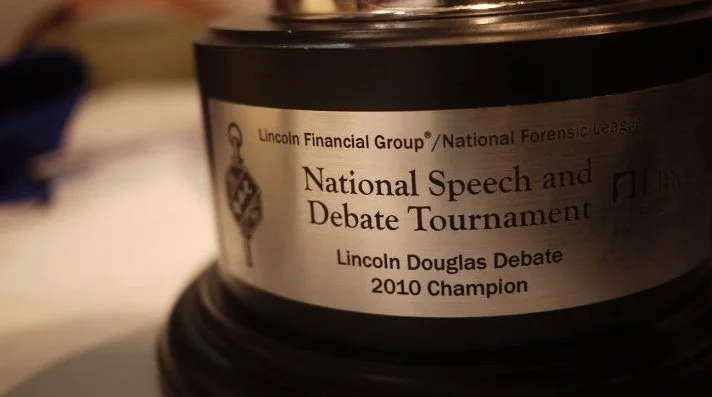
“Mike Bietz was one of the truly exceptional teachers I've had in my life. As coach, he cultivated a team environment that was both encouraging and supportive. He fostered our curiosity and motivated us into hard work. He taught us to navigate the emotions of competition, to ride the highs and lows. Learning to debate was a transformative experience for me. I am forever grateful that Mike Bietz was my coach.”
Ben Sprung-Keyser
Harvard-Westlake '11. Harvard College '15. Rhodes Scholar
Associate Professor, The Wharton School, University of Pennsylvania NSDA Lincoln-Douglas National Champion, 2010, as a junior. World Universities Debating Champion.
MY APPROACH TO COACHING
My primary job is giving a debater confidence, and confidence comes from preparation: knowing your own argument well enough to defend it under pressure and knowing the other side's argument well enough to answer it. That means I will tell a student when I think an argument is not working, because they cannot build confidence on something I only pretended to agree with.
A while back, as part of some professional development, I took one of those questionnaires meant to identify what you value. The first thing it named, by a wide margin, was a student's autonomy. The second was making a kid feel like they belong in a community. Both depend on confidence. You cannot have autonomy in a round if you do not trust your own ability to think, reason, and see the case against you; without that, you are running someone else's arguments and hoping. And you cannot feel like you belong in a room if you do not have the confidence to be part of what is happening in it. You will feel like you are standing outside it, even while you are standing in it.
I do want students to win, though I’ve always hated losing way more than I like winning. My very best debaters also learned to feel the same way, which is what kept them working. Chasing ballots, though, is not how you get there. You cannot control whether a judge votes for you, so a win-loss record is a poor measure of whether a debate career was worth anything, and I am not going to be another adult telling a student they should be winning more. Most of them already have plenty of those. A ballot is one round. What carries across rounds is better arguments, better case writing, better rebuttals, better research, better communication. So that is where the work goes.
In practice, here is what I try to teach:
The most important thing a kid learns in debate is how to lose and get right back up and do it again. I am not one of those people with a grudge against participation trophies: I think kids should be rewarded for putting in the time and effort to participate, and that should be celebrated. But kids need practice losing while the stakes are still small, so they know how to handle it when the stakes are bigger.
Relying on secrecy or surprise does not hold up. It backfires at the worst possible time, especially when you have never learned to handle clash.
Ninety percent of a debate can be won before you walk into the round.
Framing the question is the most important part of winning it.
Judge adaptation is overrated. A judge who makes the round about their own preferences should get over themselves, and the debaters who last are the ones who learn to win in front of whoever is sitting there.
Highlight clash early and explicitly.
Most debaters waste cross-examination. It should be prepared like any other block, not improvised.
"Since working with [coach Bietz] We've seen tremendous growth not only in my son's debate skills, but also in his confidence, critical thinking, and ability to communicate effectively."
Jasmine, parent
What A Session Is
A private session is thirty or sixty minutes on one student's work. What that looks like depends entirely on where they are.
Sometimes it is a case that is not doing what they think it is doing. Sometimes it is an argument they keep losing to and cannot figure out why. Sometimes it is a flow from a round that went badly and we work out where it turned. Sometimes a student is new to the event and we start at the beginning.
These sessions are about arguments rather than delivery. I do not listen to practice speeches or review recorded rounds. If your student needs speaking reps, that is what a practice round is for, and it is also what their teammates and their coach are best placed to give them.
What does not happen is me writing it for them. I do not write cases or cut cards. Your student does that work, and I tell them where it is going wrong, how to word the answer, and what they are going to hear next time. That distinction matters to school coaches, and it matters more to the student, because the point is that they can do it without me next season.
Thirty minutes or sixty. Thirty is enough for one thing: a block, a contention, a round. Sixty is right when there is more to get through or when a student is newer and needs the material as well as the feedback. Most families end up using both, which is why the packages are sold in hours rather than sessions.
Or bring up to three more students. Any session can take up to four students. An additional student is $40 for an hour or $20 for thirty minutes, so an hour with four students is $300, or $75 each. Teammates working on the same case, partners in Public Forum or World Schools, or a few friends on the same topic all work well this way. Book it as you would any other session and tell me who is coming. The session still runs on one agenda, so this works when the group wants the same thing and works poorly when each student arrives with a different problem.
"Coach Bietz is always prepared for every lesson and provides advantageous advice. He maintains consistent contact and is always easy to reach."
Jundi, student
How This Works With Your School Program
I spent my career running school programs and I built this for students who are on one. Your student competes for their own school, and nothing I do replaces their coach.
A head coach runs practice for a whole team, on top of entering the tournament, arranging travel, finding judges, and getting everyone on the bus Saturday morning. Practice covers what the room needs that week, which is how it should work. A private session is additional help on top of that, the way a tutor is in any other subject, with the hour going to one student and whatever that student wants to work on.
I do not run a shared evidence pool, coordinate prep among students, or give pre-round or opponent-specific coaching. What your student learns here is theirs, and they are welcome to share their notes with their teammates.
I also do not set myself against your student's coach. If your student tells me their coach wants something done a particular way, we work inside that. I will not always know what their coach has told them, so if my advice ever conflicts with theirs, I tell your student to follow their coach.
Whether you tell your coach is up to you, and most families treat this like any other tutoring. If your student's coach wants to be involved, I am glad to make time for that at any point in the season.
What It Costs
Save $40
4 Hours
$680
$170 an hour
- Use in 30 or 60 minute sessions
- LD, PF, World Schools, or MSPDP
- Add up to 3 students, $40 an hour each
- Book through my calendar
- Good for twelve months
Save $160
8 Hours
$1,280
$160 an hour
- Use in 30 or 60 minute sessions
- LD, PF, World Schools, or MSPDP
- Add up to 3 students, $40 an hour each
- Book through my calendar
- Good for twelve months
Save $360
12 Hours
$1,800
$150 an hour
- Use in 30 or 60 minute sessions
- LD, PF, World Schools, or MSPDP
- Add up to 3 students, $40 an hour each
- Book through my calendar
- Good for twelve months
Single sessions are available without a package.
Hours in a package are good for twelve months and can be used in thirty or sixty minute sessions, whichever the week calls for. A session canceled with less than 24 hours notice counts as used.
Any session can take up to four students. An additional student at the time of booking individual appointments is $40 for an hour or $20 for thirty minutes.
Students enrolled in the LD Seminar pay 15% less on all of it. That is $85 for thirty minutes and $153 for an hour without a package, and $580, $1,088, or $1,536 for the three packages.
What it costs when students share a session
Standard
| Package | 1 student | 2 students | 3 students | 4 students |
|---|---|---|---|---|
| Single session$180 an hour | $180$180 total | $110$220 total | $87$260 total | $75$300 total |
| 4 Hours$170 an hour | $170$170 total | $105$210 total | $83$250 total | $73$290 total |
| 8 Hours$160 an hour | $160$160 total | $100$200 total | $80$240 total | $70$280 total |
| 12 Hours$150 an hour | $150$150 total | $95$190 total | $77$230 total | $68$270 total |
Seminar members 15% less
| Package | 1 student | 2 students | 3 students | 4 students |
|---|---|---|---|---|
| Single session$153 an hour | $153$153 total | $97$193 total | $78$233 total | $68$273 total |
| 4 Hours$145 an hour | $145$145 total | $93$185 total | $75$225 total | $66$265 total |
| 8 Hours$136 an hour | $136$136 total | $88$176 total | $72$216 total | $64$256 total |
| 12 Hours$128 an hour | $128$128 total | $84$168 total | $69$208 total | $62$248 total |
From Parents who have worked with me
"Within a short amount of time, Mike was able to guide her to build strong cases and helped her to understand the philosophy, logic, real-world examples, and how to respond to answers. Every one-hour session is fulfilling without any minutes wasted. My daughter performed very well during the recent tournament, and I am happy to see her regain her confidence in competition."
Ning, parent
"Despite no prior knowledge of the LD format and no school team or coaching, she consistently earned speaker awards and went to breakout rounds at competitive tournaments. Most of all, her weekly sessions helped build her confidence throughout the season."
Danielle, parent
"Mike helped my daughter transition from PF to LD. Though she was resistant at first, she found his lessons engaging, fun, and informative. In a very short period, she started breaking into elims and feeling more confident. His passion for debate was truly inspiring for my daughter, who's at a school that's just starting to build its debate program."
Nhu, parent
HOW BOOKING WORKS
Buy hours, then book. Purchase a package and you get a code. Use it on my calendar whenever you want a session, in thirty or sixty minute blocks, and the minutes come off your balance. You can see what you have left at any time.
Or book one session. No package required. $100 for thirty minutes, $180 for an hour.
Book at least 48 hours ahead. That is the window my calendar shows. If you need something sooner, or a time you do not see on the calendar, ask. I will accommodate it if I can.
Tell me what you want to work on, at least 48 hours before. This is the single thing that makes a session better. The more specific you are, the more prepared I am when we start. "My case is not working" gives me something. "The second contention feels weak and I keep losing to the framework they read at Berkeley" gives me a great deal more, and we spend the whole session on the problem instead of finding it. For a group session, whoever books sends the agenda for the group.
Slots are most weekdays, and weekends by request. There are a limited number each week, so if you know you want several in a short stretch, book them early.
Twenty-four hours to cancel. A session canceled with less notice than that counts as used. It is the only way a calendar like this works.
Sessions are usually recorded so a student can go back to them. Recording depends on whatever video platform we are using, and every so often a file fails to save or comes back unusable, so treat the recording as a bonus rather than as the reason to book. Recordings are for the student and their family, and I do not share them with a coach. A parent or guardian can ask for a recording of their own student's session and I will send it with reasonable notice. In a group session, the recording goes to everyone who was in it.
Recordings are not shared. A recording is for the student who was in the session and their parent or guardian, and it stops there. Do not post it, send it to teammates, or pass it to a coach. I hold to the same rule from my side and do not share a recording with anyone else, including a coach who asks. A session is a student working on something they have not figured out yet, and neither of us wants that in front of an audience. A parent or guardian can ask for a recording of their own student's session and I will send it with reasonable notice. In a group session, everyone who was in the room can have the recording, and the same restriction applies to all of them.
"Mike explained complex ideas very clearly and was easy to talk to. He was also willing to answer questions via email outside of meetings, which was always helpful at debate tournaments."
May, student
Questions
-
Lincoln-Douglas, Public Forum, World Schools, and Middle School Public Debate.
-
No. Some of the students I work with are in their first season. If you are unsure, book a consultation and we will talk about where they are.
-
Yes. Any session can take up to four students. An additional student is $40 for an hour or $20 for thirty minutes. It works best when the group is working on the same thing, and whoever books tells me what the group wants to cover.
-
The session time comes off your balance the same as any other. The additional students are paid at booking.
-
No. I will read it, tell you what is not working, and work through how to fix it. Your student does the writing and the research. That is the part that makes them better.
-
No. Private sessions are about arguments rather than delivery.
A better way to work on speaking would be to book practice rounds.
-
It happens occasionally and it is a limitation of the video platform. This is one reason I ask students to take notes during a session. The notes are what they will actually use later.
-
No. Your student competes for their own school and my advice never overrides their coach's. There is more on this above, in how this works with your school program.
-
Private sessions are between me and the student. I do not share recordings or notes from a session with a coach, and neither should your student. If a coach wants to talk with me about how their student is developing, I am glad to make time for that.Through the end of the term you enrolled in, plus a month. Recordings are for viewing and are not downloadable.
-
I guess you could, if you find an opponent. But I also offer practice rounds sold separately at a flat rate, which works out cheaper than drawing them from a package. Book Practice Rounds.
-
Ask. Email mkb@debatematters.org or text my office line at (213) 293-5899. I will accommodate it if I can.
-
Email me. I would rather work something out than have a student miss the season.
Book a Consultation
If you are not sure how much time your student needs, or whether this is the right thing at all, book a short call. Tell me about your student and I will tell you what I think.
There is no charge and no obligation. If the answer is that they need something else right now, I will say so.
Or reach me directly. Email mkb@debatematters.org or text my office line at (213) 293-5899.